

How Can You Verify Clean Beauty Product Labels?
Last Updated: November 17, 2026
Quick Summary
To verify clean beauty labels, read the ingredient list rather than the front-of-pack claims, since "clean" is a marketing term with no single legal standard. Confirm the exact product first, then check the flagged ingredients against at least two independent sources.
- Ingredients are generally listed in descending order of concentration, so the first five make up most of the formula.
- Fragrance or parfum can hide many chemicals, and "fragrance-free" is a useful filter for sensitive skin.
- Ingredients at or below 1% can appear in any order, so their position does not show their dose.
- Check the batch code, size, and market before trusting an online ingredient list for a product.
- When app scores conflict, find the ingredient driving the low score and confirm the formula version.
Table of Contents
- What Clean Beauty Means and Why Labels Can Mislead
- How to Read Cosmetic Ingredient Labels Step by Step
- Clean Beauty Certifications and What They Actually Prove
-
A Repeatable Workflow to Verify Clean Beauty Product Labels Online
- Step 1: Capture the exact product identity
- Step 2: Transcribe the ingredient list from the package
- Step 3: Read the list using label mechanics
- Step 4: Cross-check against independent sources
- Step 5: Resolve conflicting scores before you decide
- Step 6: Verify the claims against evidence
- Step 7: Save your record
- Using a Free Clean Product Checker Online and Resolving Conflicting Scores
- Marketing Claims, Edge Cases and Confirming the Exact Formula
- Checking Your Next Purchase Before It Reaches Your Cart
- Frequently Asked Questions
What Clean Beauty Means and Why Labels Can Mislead
Clean beauty labels are easy to misread, and many shoppers trust a word on the front of a bottle more than the list on the back.
That is the first thing to understand.
Here is what to keep in mind:
- Clean beauty is usually a marketing term about what a brand chooses to leave out.
- Natural does not automatically mean safe or gentle.
- Organic and non-toxic claims need proof, and the proof is not always easy to find.
Labels mislead most often when they lean on feelings. Plant pictures, soft colors, and words like "pure" can make a bottle feel safe. The ingredient list tells the real story.
How to Read Cosmetic Ingredient Labels Step by Step
Cosmetic ingredient labels follow a standard format. In most markets, ingredients are listed using INCI names, which are the internationally agreed names for each ingredient. Learning a few basic rules makes the list much easier to read.
Ingredient order and concentration
Ingredients are generally listed in descending order of concentration. The first few ingredients make up most of the product. Anything listed after 1% is usually in small amounts, and ingredients under 1% can appear in any order.
Use this quick check:
- Look at the first five ingredients. These are the core of the formula.
- Find where water, fragrance, and preservatives appear.
- Note any active ingredients you care about and see how far down they sit.
A product that lists a "clean" ingredient first but buries a harsh one further down may still be a fit for you. Order tells you what dominates the formula.
Spotting red flag ingredients
Not every unfamiliar name is a problem. Some red flags are worth a closer look:
- Fragrance or parfum: This single word can hide many chemicals. Brands are not required to list each one, so "fragrance-free" is a useful filter if you have sensitive skin.
- Certain preservatives: Some preservatives are known to irritate skin for some people. Check the ingredient name against an independent database.
- Artificial color additives: Listed with codes such as "CI" followed by numbers. These are common and not always needed.
Watch out: A long list of unfamiliar names does not automatically mean a product is unsafe. Use the list as a starting point, then check each concern against a reliable source.
Clean Beauty Certifications and What They Actually Prove
Certification seals can add confidence, but each one covers different things. Browse our vetted clean beauty gift sets to see which certifications apply to each set. Some check ingredients only. Others check manufacturing, animal testing, or farming practices.
Here is how to think about common labels:
- Organic certifications usually focus on how ingredients are grown, not whether the final product is safe for everyone.
- Vegan and cruelty-free labels describe animal use and testing, not chemical content.
- Ingredient-based certifications may limit a specific list of substances, but they rarely cover every ingredient.
A certification is a useful signal, not a guarantee. Ask what the seal checks, who runs the program, and whether the brand publishes its full formula.
A Repeatable Workflow to Verify Clean Beauty Product Labels Online
A simple routine saves time and keeps your checks consistent. The key is to treat verification as a sequence: first confirm you are looking at the right product, then read the label, then check it against independent sources, then resolve any disagreements. Most shoppers skip straight to a scanning app and end up checking a formula that is not the one in their hand.
Step 1: Capture the exact product identity
Before you look up a single ingredient, write down the identifiers that distinguish this product from every similar one:
- Brand and full product name, including the variant (for example, "fragrance-free" versus the scented version of the same line).
- Size and packaging type. Sample, travel, and full sizes can use different formulas.
- Batch or lot code printed on the carton or base of the bottle. This is the manufacturer's own identifier for the specific production run.
Watch out: A barcode scan can return a product record that is outdated or for a different market. Treat the scan as a starting point, not proof that the online list matches your package.
Step 2: Transcribe the ingredient list from the package
Copy the list exactly as printed, in order, including INCI names and any parenthetical common names. Do not rely on a retailer's summary or a photo of an older package. If the label uses a folded or peel-back panel, photograph it flat so you can read the full list.
Step 3: Read the list using label mechanics
Apply the reading rules before you open a database:
- Ingredients are generally listed in descending order of concentration; the first five make up most of the formula.
- Ingredients present at or below 1% may appear in any order after the higher-concentration ingredients, so a "clean" ingredient near the bottom is not evidence of a meaningful dose.
- Fragrance/parfum can stand in for an undisclosed mixture; CI numbers identify color additives; botanical names (for example, Butyrospermum parkii for shea butter) can look unfamiliar but are ordinary plant ingredients.
Step 4: Cross-check against independent sources
Look up the ingredients you flagged, not every name on the list. Use at least two independent sources: an ingredient database or scanning app, plus a dermatology or allergy resource for sensitizers. Record what each source says and why.
Step 5: Resolve conflicting scores before you decide
Different apps often score the same product differently. When that happens, work through the disagreement rather than averaging the scores:
- Identify the driver. Find the single ingredient or two pulling the score down. A low score is often about one fragrance or preservative, not the whole formula.
- Compare the rating criteria. Some tools rank hazard (whether an ingredient is linked to any concern), while others attempt risk (whether your exposure is likely to matter). Hazard-based scores tend to look scarier.
- Check the evidence quality. A rating built on animal studies at high doses is not the same as one built on human patch-test data at cosmetic levels.
- Check the exposure assumptions. Leave-on versus rinse-off, face versus body, and frequency of use all change real-world exposure.
- Confirm the formula version. If the app's record predates a reformulation, the score may describe a product that no longer exists.
A practical rule most practitioners use: treat a score as a question to investigate, not a verdict. If two sources disagree, the ingredient list and your own sensitivity history should decide.
Step 6: Verify the claims against evidence
Match each front-of-pack claim to something checkable: a certification scope, a published full ingredient list, or a manufacturer statement. If a claim cannot be tied to any of these, treat it as marketing language.
Step 7: Save your record
Keep a short note with the product identity, the date you checked, the sources you used, and your decision. Formulas change, so a record lets you recheck quickly and spot reformulations.
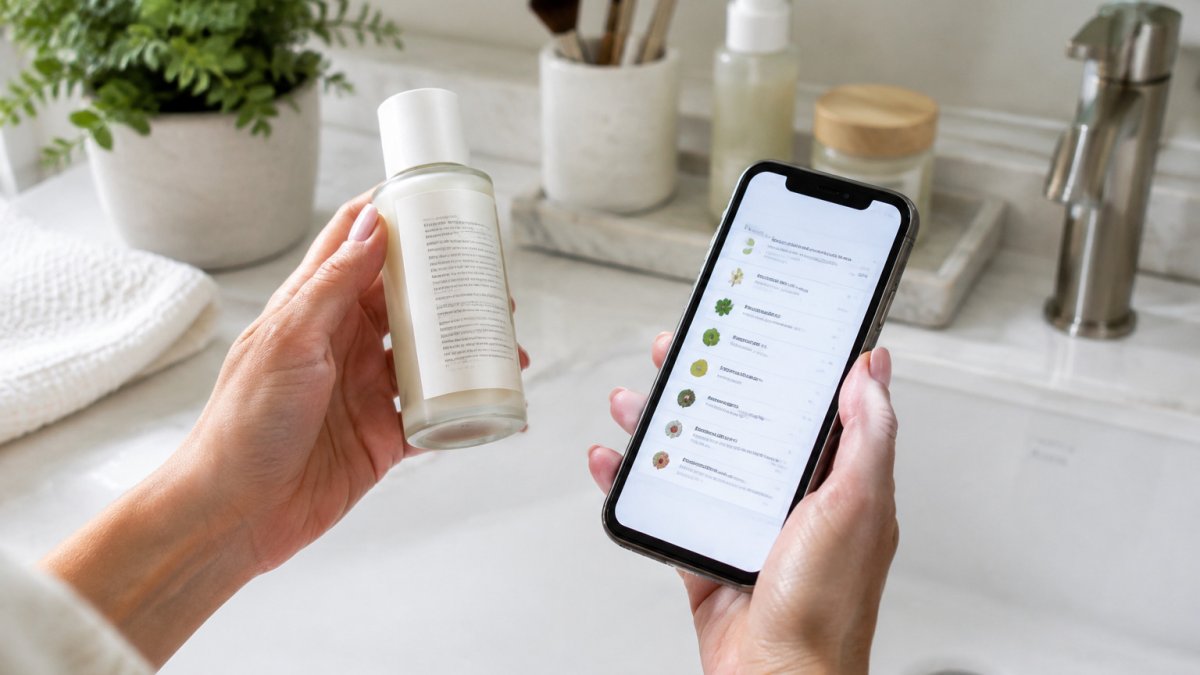
!Close-up of hands holding a skincare bottle beside a smartphone open to an ingredient checking app, in a bright bathroom counter setting
Using a Free Clean Product Checker Online and Resolving Conflicting Scores
Free clean product checkers can speed up your research. Many let you search by product name or scan a barcode.
When scores conflict, try this:
- Check which ingredient is driving the low score. Often it is one item, such as a fragrance or preservative.
- Look at the rating method. Some tools weigh hazards differently than others.
- Confirm the product version. Formulas change, and older data can produce wrong results.
No single app should make the final call. Use the checker to find questions, then answer them with the ingredient list and a second source.
When free checkers disagree, these steps help you work out why and decide what matters for your skin.
| Step | What to do | Why it matters |
|---|---|---|
| Identify the driver | Find the one or two ingredients lowering the score | A low score is often one fragrance or preservative |
| Compare rating method | Check whether the tool rates hazard or risk | Hazard-based scores tend to look scarier |
| Confirm product version | Check the formula matches your package | Older data can give wrong results |
| Decide what matters | Weigh the flag against your own sensitivities | A flagged fragrance may not matter to you |
Marketing Claims, Edge Cases and Confirming the Exact Formula
Marketing claims are where labels mislead most often, because the words on the front are not held to the same standard as the ingredient list on the back. If you are checking pet items too, see our guide to identifying non-toxic pet grooming products. The useful skill is separating claims that have a formal definition or oversight in a given market from claims that are essentially the brand's own language.
Claims with formal meaning versus marketing language
Rules vary by country, so treat this as a starting map rather than legal advice:
- "Organic" is regulated in many markets for agricultural ingredients and has certification schemes, but a cosmetic product labeled organic is not automatically safer for your skin.
- "Natural" has little consistent legal definition for cosmetics in most markets; it usually describes origin, not safety.
- "Clean" and "non-toxic" are largely marketing terms with no single agreed standard. They describe what a brand chooses to leave out, not a verified safety status.
A claim is only as strong as the evidence behind it. If a brand cannot point to a certification scope or a published full ingredient list, read the claim as positioning rather than proof.
Practical label edge cases
These are the situations where a quick check goes wrong:
- Ingredient aliases and botanical names. The same substance can appear under an INCI name, a common name, or a Latin botanical name. Check synonyms before you conclude an ingredient is absent.
- Fragrance disclosure. "Fragrance" or "parfum" can hide a mixture of many components. "Fragrance-free" is a more useful filter for sensitive skin than "unscented," which can still contain masking fragrance.
- Color additives. Listed as CI numbers; they are common and usually not the ingredient driving a concern.
Watch out: A retailer's product page can lag behind a reformulation. When the package and the website disagree, the package in your hand and the manufacturer's current statement should win.
Confirming the exact formula with the manufacturer
When the label is ambiguous or sources conflict, contact the brand and ask for the full ingredient list for the exact product, size, market, and batch you plan to buy. A transparent brand will answer clearly and specifically; a vague answer is itself useful information about how much weight to give the front-of-pack claims.
Checking Your Next Purchase Before It Reaches Your Cart
Before you add a product to your cart, pause and run the workflow. For a quick reference on food items, read our label checklist for buying non-toxic dog treats online. Confirm the exact product, read the first five ingredients, check your flagged items, and compare one or two independent sources.
Browse our selection of premium wellness and beauty products and add the items that fit your routine to your cart.
Frequently Asked Questions
How can I tell if a beauty product is really clean?
No single label proves a product is clean, because 'clean' has no official legal definition in most markets. Start by reading the full ingredient list rather than the front-of-pack claim, then check whether the ingredients you care about are present and at what position. Confirm the exact product and formula code against the manufacturer's site, and look for a recognised third-party certification where it matters to you. Combining these steps gives a far more reliable answer than any one claim alone.
Are clean beauty ingredient checker apps reliable?
Ingredient checker apps are useful starting points, but their scores often differ because each uses its own criteria and hazard databases. One app may flag an ingredient that another rates as low concern. Treat scores as prompts for further reading, not verdicts. Check the reasoning behind a flag, cross-reference the ingredient's INCI name, and make sure the app is scoring the same formula you are holding, since reformulations are common.
Do certifications prove that a beauty product is clean?
Certifications show that a product met the specific standards of the body that issued them, and those standards vary widely. Some seals verify organic farming inputs, others address cruelty-free testing or restrict certain ingredients. None automatically means a product is free of every ingredient you wish to avoid. Read what each certification covers, check whether the seal applies to the whole product or only part of it, and confirm the certificate is current on the certifier's own register.
What is the difference between clean, natural, and organic beauty?
Natural and organic describe where ingredients come from and how they are grown or processed, and both can be defined by specific standards. Clean is a broader marketing term without a single agreed definition, so brands apply it differently. A product can be natural and still contain ingredients some people avoid, and a synthetic ingredient is not automatically harmful. Judge each claim against the ingredient list and any named certification instead of the word alone.
