

How to Identify Non-Toxic Pet Grooming Products
Quick Summary
To identify non-toxic pet grooming products, read the full ingredient list rather than trusting front-label claims like natural or organic. Check the first five ingredients, watch for harsh sulfate surfactants, undisclosed fragrance and artificial dyes, and confirm the label names your species.
- Ingredients are listed from highest to lowest concentration, so the first five show most of the formula.
- Watch for sulfate surfactants such as sodium lauryl sulfate and sodium laureth sulfate.
- The word fragrance can hide dozens of undisclosed compounds, so fragrance-free products are easier to screen.
- Patch test on the inner thigh or behind the ear and watch for 24 hours before full use.
- Choose a brand that publishes its full ingredient list online and names the species on the label.
Table of Contents
- Why Label Claims Alone Don't Tell You Whether a Product Is Non-Toxic
- How to Read a Pet Grooming Ingredient Label, Step by Step
- How to Choose Safe Grooming Brands for Dogs and Cats
- Cats Need Different Screening: Species-Specific Safety Checks
- What to Ask a Pet Groomer About the Products They Use
- Patch Testing, Rinsing and Storing Your Grooming Products Safely
- Frequently Asked Questions
Why Label Claims Alone Don't Tell You Whether a Product Is Non-Toxic
Walk down any pet aisle and you will see words like "natural," "organic," and "non-toxic" on almost every bottle.
That is why learning how to identify non-toxic pet grooming products starts with the label, not the front of the bottle. A good label gives you facts you can check.
Here is what label claims usually fail to tell you:
- Which specific ingredients are inside. "Plant-based" can still include harsh surfactants.
- Whether the product has been independently tested. Self-declared claims are not the same as third-party checks.
- How the product should be used. Dilution, rinsing time, and contact with eyes all affect risk.
ASPCA guidance on pet safety and household products
Treat claims as a starting point. Then check the ingredient list yourself.
How to Read a Pet Grooming Ingredient Label, Step by Step
Reading a pet grooming ingredient label takes about two minutes once you know the pattern. Follow these steps in order, then use the screening checklist below to decide whether a product deserves a spot in your grooming kit.
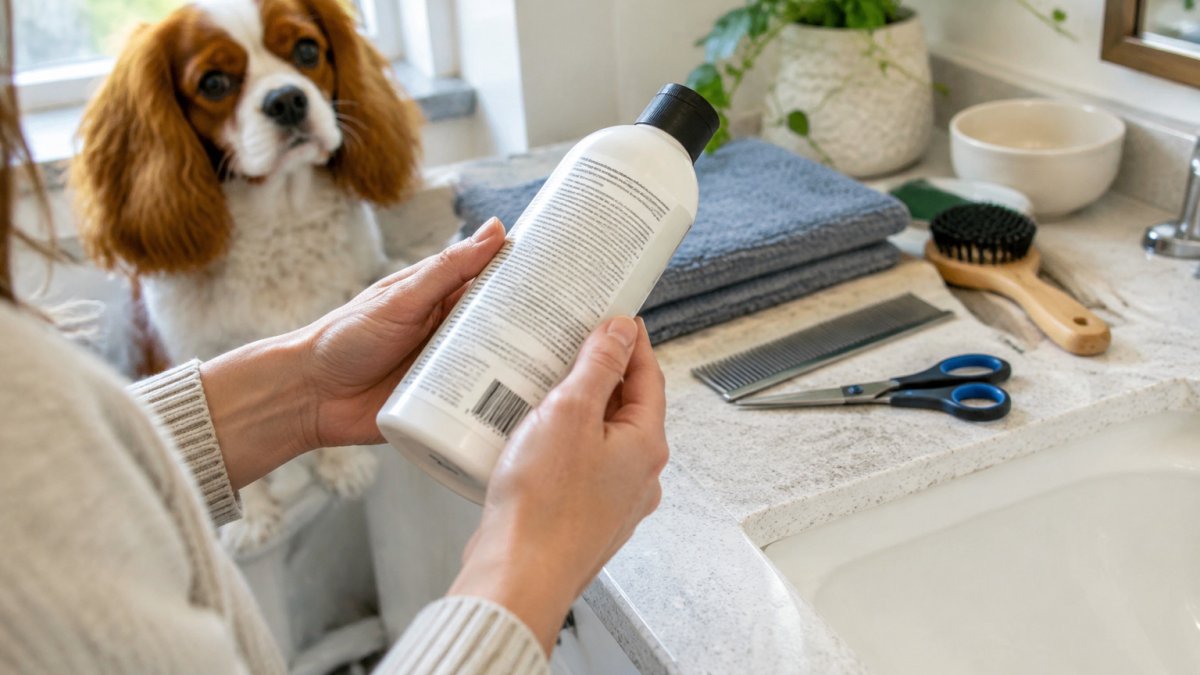
- Find the full ingredient list. Ingredients are listed from highest to lowest concentration, so the first five ingredients tell you most of what the product is made of.
- Scan the first five ingredients. If a harsh surfactant or a vague fragrance term appears near the top, the product is not a gentle formula regardless of what the front label says.
- Look for surfactants. Cleansing agents usually end in "-sulfate," "-eth," "-glucoside," or "-betaine." Some are mild; others strip oils and irritate sensitive skin.
- Check for fragrance. The single word "fragrance" or "parfum" can stand in for dozens of undisclosed compounds. "Essential oil blend" is not automatically safer.
- Note the preservatives. Water-based products need preservatives to prevent bacterial growth. Know which ones you are comfortable with rather than assuming all preservatives are bad.
- Confirm the species. A label that names only dogs is not a cat product, even if the formula looks mild.
Watch out: a long ingredient list is not automatically worse, and a short one is not automatically safer. Focus on which ingredients are present and at what position.
A Practical Ingredient Screening Checklist
Use this checklist while shopping, and watch for the aliases listed in parentheses.
- Sodium lauryl sulfate (SLS; also sodium dodecyl sulfate). A strong anionic surfactant that can dry skin and worsen irritation. Often found in high-lather shampoos.
- Sodium laureth sulfate (SLES; sodium lauryl ether sulfate). A milder sulfate than SLS but still a potential irritant for sensitive pets.
- Cocamidopropyl betaine. A milder surfactant, but it can cause contact reactions in some animals; watch for redness at the application site.
ASPCA guidance on pet safety and household products
A useful habit is to photograph the label in the store and compare it against this list at home. If a brand will not publish a full ingredient list online, treat that as a screening failure rather than a minor inconvenience.
Ingredients to Avoid in Dog Shampoo
Some ingredients appear often in shampoos and deserve a closer look. Not every product with them is harmful, but they are common irritants.
- Strong sulfate cleansers, such as sodium lauryl sulfate, which can dry out skin and strip the coat's natural oils
- Synthetic fragrances, which are a frequent source of itching and redness
- Parabens and formaldehyde-releasing preservatives, which some owners prefer to avoid and which can trigger reactions in sensitive animals
American Kennel Club guide to dog skin care
Why Fragrance-Free Matters More Than "Natural"
"Natural" does not by itself mean gentle. Plant-derived ingredients can still cause reactions. "Fragrance-free" is a more concrete label than "natural" because it refers to a specific absence of added fragrance.
Fragrance-free products are one option to consider when screening for sensitive skin.
The checklist below summarises the ingredients this article flags for closer screening, with the common aliases to watch for on labels.
| Ingredient | Also listed as | Why it matters |
|---|---|---|
| Sodium lauryl sulfate | SLS; sodium dodecyl sulfate | Strong surfactant that can dry skin |
| Sodium laureth sulfate | SLES; sodium lauryl ether sulfate | Milder sulfate, still a potential irritant |
| Cocamidopropyl betaine | Surfactant | Can cause contact reactions in some animals |
| Parabens | Methylparaben, propylparaben, butylparaben | Preservatives some owners prefer to avoid |
| Formaldehyde-releasing preservatives | DMDM hydantoin, diazolidinyl urea, imidazolidinyl urea, quaternium-15 | Slowly release formaldehyde; can trigger reactions |
| Phthalates | Often hidden under "fragrance" | Used to stabilise scent; rarely named |
| Essential oils | Tea tree, peppermint, eucalyptus, citrus, wintergreen, clove | Plant-derived but not automatically gentle |
| Artificial colours | CI numbers, FD&C or D&C dyes | Cosmetic only; can trigger sensitive skin |
How to Choose Safe Grooming Brands for Dogs and Cats
Choosing a brand is easier when you have a short checklist. Look for these signs before you buy.
- Full ingredient lists published online, not just on the bottle
- Clear dilution and rinsing instructions
- Species-specific labeling for dogs, cats, or both
A straightforward, skin-friendly tool to consider is the Pet Slicker Brush for Cats & Dogs. It has rounded safety tips, fine stainless steel bristles, a one-click self-cleaning release, and is suitable for dogs and cats with long or short hair.

A second option to look at is the Self Cleaning Slicker Brush, which has skin-friendly massage needle tips and is designed for deshedding.

Cats Need Different Screening: Species-Specific Safety Checks
Cats can react differently to some products than dogs do, so check that a label names cats specifically.
Before using any product on a cat, check that the label names cats specifically. Check the label for essential oils before use on a cat.
Cats also groom themselves constantly. Anything you apply to their coat, they may swallow. Rinse thoroughly and choose products that are safe if ingested in small amounts.
Cornell Feline Health Center on grooming and skin health
What to Ask a Pet Groomer About the Products They Use
If you use a professional groomer, the products matter as much as the haircut. Ask direct questions before booking, and listen for whether the answers are specific or vague. A good groomer will answer clearly and welcome follow-up.
Product and Dilution Questions
- Which shampoos and conditioners do you use, and can I see the ingredient lists?
- Do you carry fragrance-free options for sensitive pets?
- How do you dilute products, and how long do they stay on the coat before rinsing?
Dilution is the question most owners skip. A groomer who can state the dilution ratio and contact time gives you more specific information than one who says only that they use "a gentle shampoo."
Evaluating the Service, Not Just the Bottle
Product choice is only part of the exposure. The grooming environment and handling style also affect risk, especially for cats and anxious pets.
- Ventilation. Ask whether the grooming area is ventilated and whether drying is done in a separate space. Strong airflow reduces airborne exposure to shampoo mist and drying fumes.
- Handling and restraint. Ask how the groomer handles a pet that becomes stressed. Calm, low-stress handling reduces the chance of product getting into eyes or ears during a struggle.
- Species separation. Cats and dogs should not be groomed in the same immediate area if one is reactive; ask how the schedule keeps them apart.
A groomer who welcomes these questions is usually more transparent about their whole process. One who dismisses them or cannot name the products is a reason to keep looking.
Mobile Grooming Adds a Few Extra Checks
Mobile grooming vans concentrate products, water, and drying equipment in a small space. If you use a mobile groomer, ask how the van is ventilated, whether water is fresh for each pet, and how products are stored between appointments.
Cornell Feline Health Center on grooming and skin health
The Dog Nail Grinder is an example of a grooming tool to ask about; its listing describes a quiet, ultra-low-noise motor and two adjustable speeds.

Patch Testing, Rinsing and Storing Your Grooming Products Safely
Even a carefully chosen product can cause a reaction, so test before full use.
Rinse thoroughly. Leftover product on the coat is a common cause of irritation, especially in cats who lick themselves.
Store products somewhere cool, dry, and out of reach of pets and children. Keep them in their original containers with labels intact, and check expiry dates.
*Zobela curates pet essentials and grooming tools for dogs and cats.
Frequently Asked Questions
Which dog shampoo ingredients should you avoid?
Look first for synthetic fragrance, which often appears as the single word "fragrance" or "parfum" and can hide many chemicals. Also check for harsh sulfates such as sodium lauryl sulfate, which can strip natural oils, and for preservatives like formaldehyde-releasing agents. Patch test any new shampoo on a small area before a full bath. Keep the ingredient list in hand when you shop and compare it against the products you already use.
Are natural or organic pet grooming products always safe?
No. "Natural" is a marketing term that is not regulated in the same way as certified organic labels, so it does not guarantee a product is non-toxic or gentle. Some natural ingredients can irritate skin. Use the ingredient list rather than the front-of-pack claim, and look for third-party certification where it exists. A short, simple ingredient list is often a better sign than a long list of botanical names.
How can you tell whether a pet grooming product is safe?
Start by reading the full ingredient list, not just the front label. Check whether the product is fragrance-free, whether it names its fragrance source, and whether it uses known irritants. Look for any third-party certification and be skeptical of claims you cannot verify. Patch test on a small patch of skin for 24 hours, and watch for redness, itching, or swelling. Stop using the product if your pet shows any reaction, and contact your veterinarian if symptoms continue.
How do I choose a fragrance-free shampoo for my pet?
Choose products labelled fragrance-free rather than unscented, because unscented products can still contain masking fragrances to cover odours. Read the ingredient list for words like "fragrance", "parfum" or essential oil names. Keep in mind that essential oils are fragrances too, even when they come from plants. A simple formula with few ingredients is easier to screen and easier to rinse out completely, which reduces the chance of skin irritation.
