

9 Non-Toxic Wooden Toys Worth Buying Online
Quick Summary
To buy non-toxic wooden toys online, check three things: the finish, the construction, and the age range. Look for named water-based or plant-based finishes rather than vague claims like natural. Solid wood joints are more durable than glued or stapled parts. Always match the toy to your child's age, since small parts pose a choking risk for children under three.
- Look for named water-based or plant-based finishes, not vague claims like natural.
- Prefer solid wood joints over glued or stapled parts that can loosen.
- Check the recommended age, since small parts are a choking risk under three.
- Confirm the listing names its wood species and finish before you buy.
Table of Contents
- What Makes a Wooden Toy Non-Toxic
- How to Choose Non-Toxic Wooden Toys
- Quick Comparison: Zobela Wooden-Style Picks at a Glance
- Non-Toxic Wooden Toys for Toddlers: Our Top Picks
- Best Non-Toxic Toy Brands and How We Evaluated Them
- Where to Buy Wooden Toys Online and What It Costs
- Your Next Step: Pick a Toy for Your Child's Age Group
- Frequently Asked Questions
What Makes a Wooden Toy Non-Toxic
Last Updated: November 7, 2026
Buying a non-toxic wooden toy online is harder than it sounds, because "natural" and "safe" are marketing words, not standards. The real test is what the wood is finished with, how the toy is built, and whether it suits the age of the child who will play with it. This guide walks through how to tell the difference before you add anything to your cart.
A non-toxic wooden toy is one where the wood, the finish and any paint have been chosen to avoid harmful substances that a child could chew, lick or swallow. Solid wood with a simple, certified finish is the common starting point. Veneers, particleboard and heavily lacquered surfaces are less predictable, so check the listing carefully before you buy.
Safe Finishes and Paints to Look For
The finish matters more than the wood for most toddler toys, because children mouth objects constantly. Look for listings that name the finish, such as water-based paints, plant-based oils or beeswax.
Be cautious with vague claims. A product described as "natural" may still carry a coating you cannot identify. If the listing does not name the finish, ask the seller before buying.
Small-Parts Hazards by Age
Small parts are the most common hidden danger in any toy, wooden or not. Parts that fit inside a standard small-parts test tube present a choking risk for children under three. Check the recommended age on each listing, and remember that a toy aimed at an older child may still be unsuitable for a toddler who puts everything in their mouth.
How to Choose Non-Toxic Wooden Toys
Start with the child's age, then check the finish, then check the construction. In that order, the decision becomes much simpler.
- Age range: Confirm the toy is labelled for your child's stage.
- Finish: Look for named, water-based or plant-based finishes.
- Construction: Prefer solid wood joints over glued or stapled parts that can loosen.
- Durability: Check whether the toy is built to survive daily chewing and dropping.
Many parents find that a shorter list of well-finished toys lasts longer than a large pile of cheap ones. That tends to be the better buy for both safety and value.
Quick Comparison: Zobela Wooden-Style Picks at a Glance
The table below summarises the Zobela products in this guide. Prices are the starting prices listed on each product page.
| Product | Starting Price | Recommended Age | Best For |
|---|---|---|---|
| Baby Learning Tablet | $14.60 | 1-6 years | Early letters and numbers |
| Interactive Learning Tablet for Toddlers | $39.99 | 1-6 years | Touch-based learning |
| Talking Flash Cards and Finger Counting Math Board | $44.98 | 3+ years | Counting and early literacy |
| Kid Sand Water Table | $53.96 | 3-6 years | Outdoor sensory play |
| Kids Play Tent Princess | $33.46 | Children playing indoors or outdoors | Imaginative play |
Starting Price

Non-Toxic Wooden Toys for Toddlers: Our Top Picks
The Talking Flash Cards and Finger Counting Math Board is designed for children aged 3 and up. The set includes a counting board, number blocks, alphabet cards and word cards, and is made from bamboo and ABS materials.
The [SHOP LINK: Interactive Learning Tablet for Toddlers] is the better choice if your child is younger and likes touch-based play. It is designed for ages 1 to 6 and works under adult supervision. Note that it is a baby learning toy, not a real tablet, and it takes AA batteries that are not included.

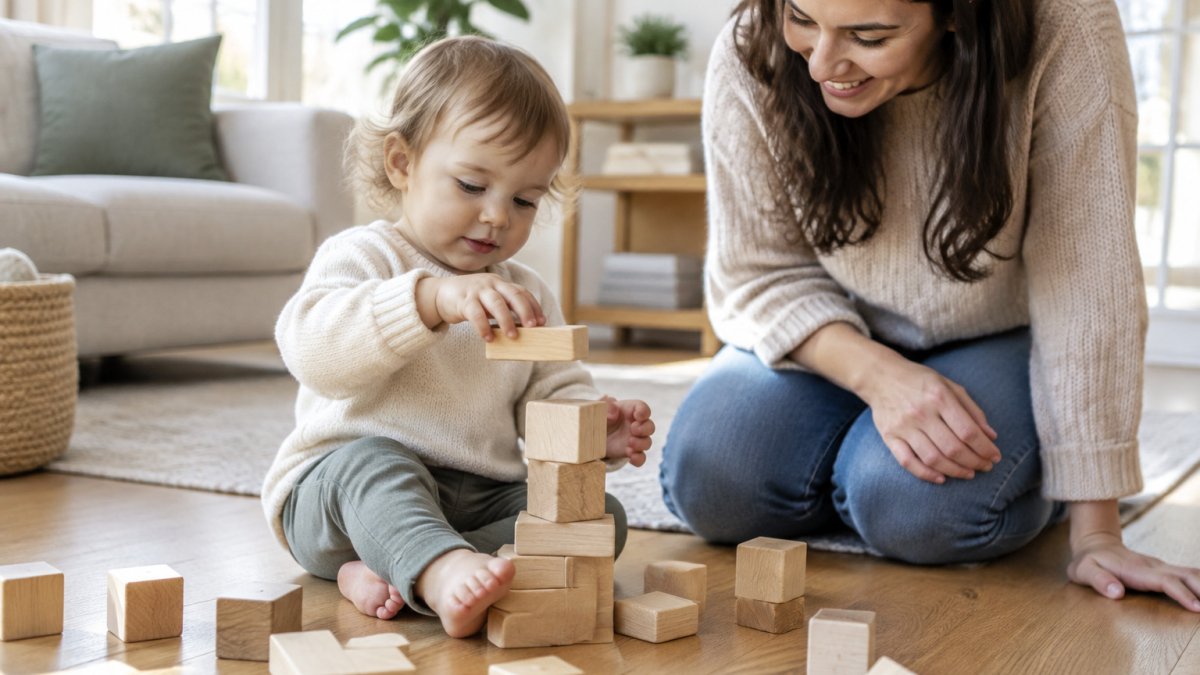
A toddler sitting on a wooden play floor, stacking natural-finish wooden blocks in a bright, sunlit living room with a parent kneeling nearby.
For outdoor play, the Kid Sand Water Table is built for children aged 3 to 6 and includes shovels, watering cans and animal figures. It is made from ABS plastic, so check the surface you place it on before the first use.
Best Non-Toxic Toy Brands and How We Evaluated Them
Choosing a toy brand is less about the name and more about the evidence behind it. Most practitioners find that the strongest listings share a few traits: they name their wood species, name their finish, state an age range, and can point to a safety standard. The weakest listings lean on words like "natural" and "premium" without any of that.
The Evaluation Criteria We Used
We assessed each product on the following, in this order:
- Material disclosure: Is the wood species named (maple, beech, rubberwood, bamboo)? Is any non-wood component named (ABS, bamboo, cotton)?
- Finish disclosure: Is the paint, oil, or wax named, and is it water-based or plant-based?
- Age guidance: Is there a stated age range, and does it match the small-parts risk?
- Safety documentation: Does the listing reference a standard such as ASTM F963 or EN 71, or offer a test report on request?
- Construction: Solid wood joints versus glued, stapled, or veneered parts.
- Durability and care: Whether the listing explains how to clean the toy and refresh the finish.
Where a listing states a material, such as bamboo and ABS or solid wood, we treat that as the basis for comparison. Where a listing is silent on the finish, we say so rather than assume.
What the Standards Do and Do Not Guarantee
A common pattern is to treat a standard mark as a safety guarantee. In practice, ASTM F963 and EN 71 cover things like mechanical hazards, small parts, and heavy-metal limits in surface coatings, they are a useful baseline, not a promise that a specific toy is right for your child. They do not tell you whether the finish is water-based, whether the wood is solid or veneered, or whether the toy will survive daily chewing. Those are listing-level details you still have to check.
A Quick Brand Checklist
Before you commit to a brand, confirm four things: the wood species, the finish, the age range, and whether safety documentation is available. A brand that answers all four is easier to trust than one that answers none, regardless of how it markets itself. For more background on the Zobela range, see our [PAGE LINK: News and background] section.
Where to Buy Wooden Toys Online and What It Costs
Buying online lets you compare materials and age guidance side by side, which is harder in a shop. Prices listed on the product pages start at $14.60 for the Baby Learning Tablet and $53.96 for the Kid Sand Water Table. Price alone does not signal safety, so use the checks in the sections above before deciding.

Read the full product description before you pay. Confirm the recommended age, the materials and any included accessories, since some listings note that colours are delivered at random.
Your Next Step: Pick a Toy for Your Child's Age Group
Start with your child's age, check the finish and construction, and choose one toy that fits the next stage of their play. Zobela carries options for toddlers, preschoolers and young children, so you can build a set over time rather than buying everything at once. Add the toy you have chosen to your cart and check the listing once more before you order.
Frequently Asked Questions
Are wooden toys non-toxic?
Not automatically. Solid wood itself is generally a safe material, but the paint, stain, varnish or oil on the surface determines whether a toy is non-toxic. Look for water-based paints, plant-based oils such as linseed or beeswax finishes, and clear labelling that names the finish. Toys made for children under three should also meet toy safety standards such as EN 71 in Europe, which limit heavy metals and other chemicals. If a seller does not state what finish was used, treat the safety claim as unverified.
Where can I buy wooden toys online?
Most shoppers buy wooden toys from specialist toy retailers, brand websites and curated online shops. When you shop online, check the product page for the finish, the age range, the materials and any safety certification before you add to cart. Product listings typically show details such as recommended age and package contents, which makes comparison easier. Read the return policy before ordering, especially for larger items such as play tables or tents.
What finishes are safe for wooden toys?
The safest finishes are water-based paints, food-grade or plant-based oils such as linseed oil, and beeswax. Avoid solvent-based lacquers and paints that do not disclose their ingredients. Unfinished or oil-finished solid wood gives children a natural surface that is easy to maintain. Zobela's Montessori-inspired counting board, for example, is described as made from bamboo and ABS, so check each listing for the exact materials used rather than assuming a finish.
Are Montessori wooden toys safe for toddlers?
Montessori-inspired wooden toys can be safe for toddlers when they are sized for the child's age and free of small parts that could be swallowed. Toys designed for ages 3 and up, such as talking flash cards and finger counting math boards, should be supervised with children under three. Younger toddlers do best with larger shapes and blocks that cannot fit inside a small-parts test cylinder.
