

Best Educational Toys for Three Year Olds: A Parent's Guide
Last Updated: November 1, 2026
Quick Summary
The best educational toys for three year olds are open-ended, hands-on toys that invite talking, sorting, and pretending, such as talking flash cards, LCD writing tablets, sand and water tables, and handheld microscopes. You can cover language, fine motor, and sensory play for well under $100 total if you pick carefully, and most families don't need all six picks.
- Three-year-olds move from parallel play to real social play, following simple rules and narrating what they do.
- Talking flash cards and learning tablets build language, alphabet recognition, and memory.
- The LCD writing tablet offers mess-free coloring with no paper or pencils and erases in one second.
- Five to ten minutes of focused observation is plenty for a three-year-old's STEM play.
- Check toys for cracks and loose parts weekly, and keep button batteries out of reach.
Table of Contents
- How Educational Toys Support a Three-Year-Old's Development
- Quick Comparison: Educational Toys for Three Year Olds
- Alphabet, Numbers, and Early Learning Toys
- STEM Toys for 3 Year Olds: Science and Problem-Solving at Home
- Toys for Fine Motor Skills for 3 Year Olds
- Pretend Play Toys for 3 Year Olds: Imagination and Social Skills
- Safe Toys for 3 Year Olds: Age Grading and Choking Hazards
- Choosing Your First Educational Toys at Zobela
- Frequently Asked Questions
How Educational Toys Support a Three-Year-Old's Development
The best educational toys for three year olds are the ones that get played with again and again, not the ones that impress on the shelf. Age three is a turning point: language explodes, pretend play takes off, and small hands want to do precise things.
That shift changes what "educational" means. A toy that taught cause and effect at 18 months now feels babyish. What works at three is open-ended, hands-on, and just hard enough to be interesting.
Below, we break down the skills behind each toy type, then show our picks with prices, safety notes, and trade-offs.
Learning Through Play: What Changes at Age Three
Three-year-olds move from parallel play to real social play. They negotiate roles, follow simple rules, and narrate what they're doing. Toys that invite talking, sorting, and pretending do more for preschool readiness than drill-style gadgets.
A common mistake is buying toys that are too advanced. A frustrated child abandons a toy faster than a bored one.
Developmental Skills Mapped to Each Toy Type
Hand-eye coordination, fine motor skills, language development, and problem-solving matter most at this age. Here's how toy categories map to them:
- Talking flash cards and learning tablets: language development, alphabet recognition, memory
- Counting boards and number blocks: early counting, sequencing, number sense
- Drawing tablets: fine motor skills, pre-writing grip, creative play
Quick Comparison: Educational Toys for Three Year Olds
Here is the short version. Every toy below is age-appropriate for three-year-olds, with the price and the main skill it builds.
| Toy | Price | Main Skills | Best For |
|---|---|---|---|
| Talking Flash Cards & Math Board | $44.98 | Language, counting, number sense | Kids ready for letters and numbers |
| Interactive Learning Tablet | $39.99 | ABCs, words, memory | Travel and quiet time |
| Baby Learning Tablet | $14.60 | Letters, songs, early vocabulary | Budget-friendly first learning toy |
| LCD Writing Tablet | $20.41 | Fine motor skills, pre-writing | Drawing and mark-making |
| Sand & Water Table | $53.96 | Sensory play, social skills | Backyard and playdate play |
| Handheld Microscope | $39.98 | Observation, problem-solving | Curious, science-minded kids |
You can cover language, fine motor, and sensory play for well under $100 total if you pick carefully. Most families don't need all six.
Alphabet, Numbers, and Early Learning Toys
Letters and numbers are the headline skills parents ask about, but delivery matters more than content. A three-year-old learns "A" by hearing it, saying it, and touching it, not by watching a screen flash it.
That's why we favor toys that combine sound, touch, and repetition. The two picks below both do that, at very different price points.
Talking Flash Cards and Finger Counting Math Board
This set includes a talking machine with 52 alphabet cards and 110 double-sided word and song cards, plus a counting board with 13 number blocks for teaching numbers, addition, and subtraction.
The adjustable volume and repeat function let you personalize the learning experience.
Best for: kids showing real interest in letters and counting. Skip if: your child is still mouthing small objects; the cards need supervision.
See the talking flash cards and finger counting math board

Interactive Learning Tablet for Toddlers
Think of this as a first "tablet" that isn't a screen. It teaches ABCs, numbers, words, and spelling through nursery songs and simple quizzes, and it's built for car rides and waiting rooms.
It runs on three AA batteries (not included) and is recommended for ages 1-6. It is a learning toy, not a real tablet, and is suitable for kids playing under adult supervision.
View the interactive learning tablet for toddlers

STEM Toys for 3 Year Olds: Science and Problem-Solving at Home
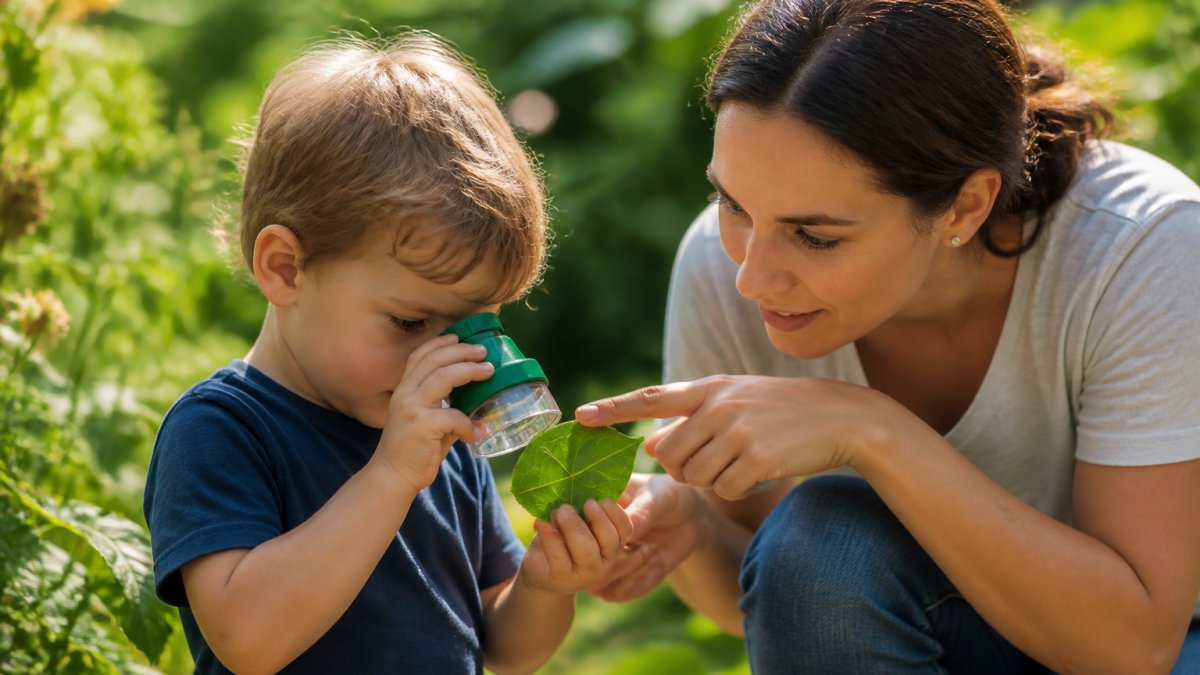
STEM toys for 3 year olds don't need to teach chemistry. They need to reward curiosity. At this age, science play is about observation, cause and effect, and the language of asking questions. A three-year-old who holds a magnifier up to a leaf and says "what is that?" is doing exactly the right work.
The best STEM toys for this age are hands-on, adult-supported, and open-ended. They should invite looking, touching, sorting, and repeating, not deliver facts.
What STEM Play Builds at Age Three
- Observation and attention: noticing details, comparing textures, tracking small changes
- Cause and effect: predicting what will happen, then testing it
- Language and vocabulary: naming parts, describing what is seen, asking questions
These map directly to preschool readiness. Short, repeated sessions work better than long ones, five to ten minutes of focused observation is plenty for a three-year-old.
Our Pick: Handheld Microscope Set with LED Light
The handheld microscope set with LED light offers 60x-120x magnification for home school and biological science learning.
How to extend play:
- Start a "collection tray" of safe found objects: leaves, flower petals, fabric scraps, a coin, a sponge
- Ask prediction questions: "What do you think the sponge will look like up close?"
- Compare two objects side by side: "Which one has more lines?"
Explore the handheld microscope set
Low-Tech STEM You Already Own
You do not need a dedicated science toy to build STEM skills. A few common household items do the same work:
Baby Learning Tablet Educational Mini Pads Toys Touch Learn Toddler Tablet →
- Stacking and balancing: wooden blocks, plastic cups, or a set of nesting bowls
- Water play: pouring between containers of different sizes teaches volume and cause and effect
- Sorting: buttons, large beads, or colored counters sorted by color, size, or shape
The key is not the object but the adult nearby asking "what do you notice?" and "what do you think will happen next?"
Toys for Fine Motor Skills for 3 Year Olds
Fine motor skills for 3 year olds develop through repetition, not instruction. Gripping, pressing, tracing, and squeezing build the hand strength that later supports handwriting.
Drawing is the most efficient way to get there. It's also the easiest to set up and clean up.
LCD Writing Tablet and Drawing Play
The 20-inch LCD writing tablet offers mess-free coloring with no paper or pencils. Line thickness changes with pressure, and the erase button empties the screen in one second. A lock key can save content.
The screen uses LCD pressure-sensitive technology and is designed to be glare-free. The battery is replaceable.

Pretend Play Toys for 3 Year Olds: Imagination and Social Skills
Pretend play toys for 3 year olds do the social heavy lifting. When two children pour, scoop, and negotiate who gets the boat, they're practicing language, turn-taking, and teamwork without anyone calling it a lesson. At three, pretend play shifts from simple imitation to real role-play: children assign roles, follow rules they invent, and narrate a story as it unfolds.
That is why the best pretend toys are open-ended. A toy with one fixed function gets old fast; a toy that can become a kitchen, a car wash, or a dinosaur habitat keeps earning its space.
What Pretend Play Builds at Age Three
- Language and narrative: storytelling, sequencing events, using new vocabulary in context
- Social-emotional skills: turn-taking, negotiating roles, expressing feelings, empathy
- Self-regulation: following rules, waiting, managing frustration when a plan changes
These are the same skills preschool teachers look for in school readiness. Children who have rich pretend play at home often settle into group settings more easily because they have already practiced sharing a plan and a space.
Our Pick: Three-Tier Sand and Water Table
The sand and water table has three tiers that create a rain-shower effect when water is poured, and it comes with animal figures, two watering cans, five shovels, and a chair.
How to extend play:
- Set up a "river" with the animal figures and ask your child to build a bridge
- Add measuring cups and talk about full, half-full, and empty
- Invite a friend and assign roles: one pours, one scoops, one arranges the animals
Choosing Pretend Toys by Play Style
Not every three-year-old pretends the same way. Matching the toy to your child's play style gets more use out of it:
- Active and physical children: sand and water tables, play tunnels, ride-on toys, and pretend tools that involve carrying and building
- Quiet and detail-oriented children: play kitchens, dollhouses, small animal sets, and pretend food that invites arranging and sorting
- Sensory-seeking children: water, sand, play dough, and textured pretend food
A simple rule: buy one open-ended pretend toy rather than several single-purpose ones. A set of animal figures, a few containers, and a scoop will outlast a battery-powered pretend kitchen that does one thing.
Safe Toys for 3 Year Olds: Age Grading and Choking Hazards
Safe toys for 3 year olds come down to checking the age grade on the box and whether an adult is nearby.
Look for age grading and safety marks where listed on the product. The talking flash card set recommends adult supervision during use to ensure safe handling of small parts.
A few practical habits that prevent most problems:
- Check toys for cracks and loose parts weekly
- Keep button batteries and small blocks out of reach
- Store cards and blocks in the included bags between sessions
Choosing Your First Educational Toys at Zobela
The right starting point depends on your child, not on a ranking. If they're drawn to letters, start with the talking flash cards and math board. If they'd rather draw than recite, the LCD writing tablet will get more use.
Educational toys work best when each piece teaches and inspires rather than piling up. The toys below each build a specific developmental skill.
Frequently Asked Questions
What are the best educational toys for a three-year-old?
The strongest picks combine a clear learning goal with open-ended play. Look for alphabet and counting sets such as talking flash cards with a finger counting board, portable learning tablets for letters and words, and drawing pads that build grip strength. Add a sensory option like a sand and water table for hands-on exploration. Rotate a small handful at a time rather than displaying everything at once, and match each toy to one skill you want to encourage that month.
What toys help develop fine motor skills at age three?
Toys for fine motor skills for 3 year olds should ask the hands to grip, pinch, press, or pour. A drawing tablet with a stylus trains a proper pencil hold without paper waste. Shovels and watering cans at a water table build wrist control and hand-eye coordination. Counting blocks encourage pinching and placing. Ten to fifteen minutes of these activities a day gives plenty of practice, and the mess-free formats make repeat sessions easy for parents.
How do I choose a safe toy for a three-year-old?
Check the age grading on the packaging first and treat it as a minimum, not a suggestion. Avoid anything with parts small enough to swallow, and inspect seams, battery compartments, and small accessories for looseness. Look for compliance marks such as CE, EN71, CPC, or UKCA where they apply. Battery-powered toys should have a secured compartment, and water or sand play needs supervision. When in doubt, choose the simpler toy with fewer detachable pieces.
Are open-ended toys better for preschoolers?
Open-ended toys tend to hold attention longer because the child decides what happens next. A water table, a drawing board, or a set of counting blocks can become a shop, a science lab, or a story. Toys with one fixed outcome get mastered quickly and then sit unused. A practical balance works best: one or two structured learning toys for letters and numbers, plus open-ended options for pretend play and sensory exploration.
How many toys does a three-year-old need?
Fewer than most families own. A workable rotation is six to eight toys available at a time, with the rest stored away and swapped every few weeks. That keeps novelty high and makes cleanup manageable. Prioritize variety across categories: something for letters and numbers, something for building or counting, something for drawing, something for pretend play, and something sensory. Quality and durability matter more than volume, especially at this age.
Start with one toy that matches how your child already plays, then add a second from a different skill area a few weeks later. Browse the Zobela educational toy collection, add your first pick to the cart, and watch which one your three-year-old returns to without being asked.
